
No clear use case yet?
Gather tasks with employees and process owners, understand the bottlenecks, then compare opportunities by value, feasibility and strategic fit.
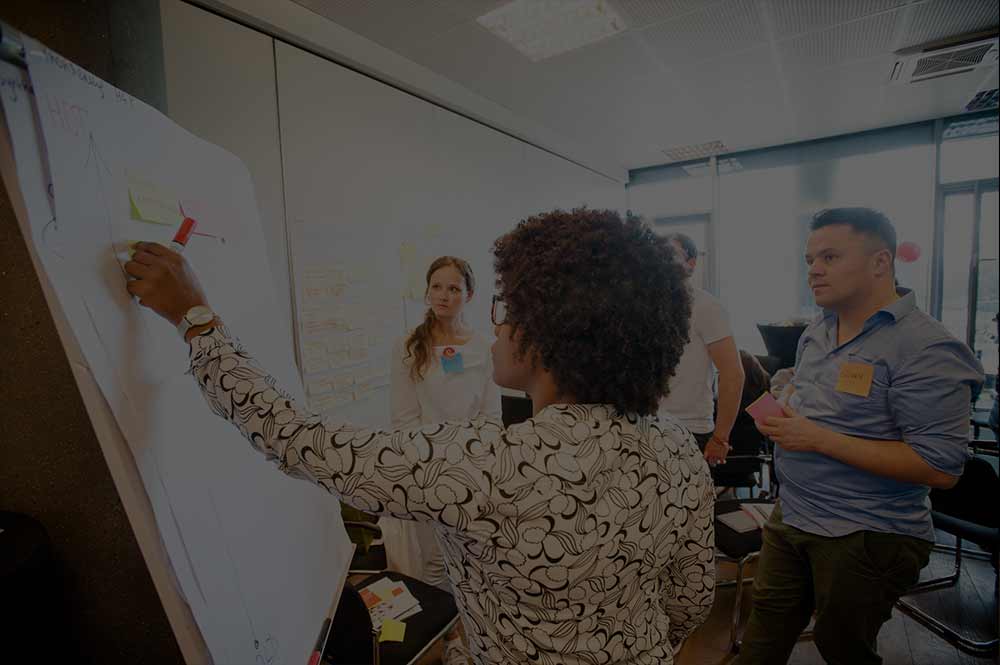
For product, business and innovation teams: prioritize opportunities, test ideas with users or build a prototype. Practitioners work with your team towards the next decision.
Product, business and innovation teams with an open opportunity or an idea to test.
Usually 5–15 people for a collaborative workshop; half a day to several days, depending on scope. Build teams are shaped around the brief.
A prioritized opportunity, a plan to gather real feedback or a demonstrable prototype. We agree on evaluation criteria and name who decides the next step.
Practitioners in product, technology, entrepreneurship and user research shape a process with your team that leads to a decision. Experience from hundreds of workshops informs the facilitation and working style. You leave with a visible result and a named owner for the next step.
Gather tasks with employees and process owners, understand the bottlenecks, then compare opportunities by value, feasibility and strategic fit.
Turn the idea into a testable assumption, identify the people affected and plan a small experiment before investing in a larger build.
Bring the relevant business and technical roles together to explore a prototype or focused build sprint.
Teams can use AI to organize approved interview notes, prepare questions, sketch concept variations or sort responses from an experiment. This can help turn a broad idea into a question that can be tested.
AI-generated personas, simulated answers and internal enthusiasm are not customer validation. In the workshop, we distinguish clearly between an assumption, model output and evidence actually gathered. Where possible, the team plans real conversations or tests with its intended audience.
Narrow the problem: Where do users or staff wait unnecessarily today?
State an assumption: What specific change could make the process clearer or easier?
Make a simple prototype: A draft response, dialogue flow, service storyboard or functional test, depending on the question.
Check with the audience: Observe real reactions and record evidence that challenges the idea.
Decide: Adapt, investigate further or stop, with an owner and date.
A hackathon can concentrate ideas and collaboration in a short time. The key question is whether the goal is learning and concept development or a technical build. Both can be valuable, but they need different preparation and success criteria.
Cross-functional teams develop and present concepts, process ideas, early click-through mockups or AI-supported ways of working. The group gets brief feedback and agrees what to investigate next.
Developers work with business teams on a limited prototype, integration or agent. The work ends with a demo and an honest view of what further work would involve.
A working day can focus on prioritization, concept testing or prototyping. This is an example agenda; we adapt it to the scope and goal.
What do we know, which assumption remains open and what should the group be able to decide today?
Bring together relevant tasks, users and evidence already available.
Sketch several approaches, assess them and select against the brief.
Work on the open question using suitable methods, AI tools and, where agreed, technical support.
What did the team actually learn? What still needs validation with users, data or technology?
Build further, test with users, prioritize internally or stop deliberately.
The work is more useful when participants tackle a relevant problem and know who can act on the result. For a technical build, we agree on the environment and access beforehand.
Helps set the focus and decide after the workshop whether to test or implement further.
Subject expertise, proximity to users or customers, and product or technical roles, matched to the question.
For experiments: access to the intended audience. For builds: an agreed test environment, data examples and technical contacts.
If the question is which AI use case matters to your business, start with this workshop. If you are weighing external market changes against your company’s position, see the separate Opportunity Lab for market change. If value or demand is uncertain, plan an experiment with real users or customers. If the problem and technical question are clear, a hackathon or build sprint may fit.
Prioritization often takes half a day or a full day. A customer experiment usually needs one to two working days, including planning and review. Build sprints depend on the technical question and agreed scope. Collaborative workshops usually have 5–15 participants; hackathon teams are sized around the challenge, roles and facilitation.
No. Prioritizing opportunities, preparing user questions and testing concepts are cross-functional activities that do not require coding. A technical build brings developers together with relevant business and product roles in a suitable test environment.
Bring a specific assumption, any evidence you already have and, if possible, access to people who can speak to the question. AI can support research, question design and analysis; validation comes from real conversations or observations.
Depending on the brief, you may leave with a prioritized opportunity and assumptions, an experiment plan with test materials or a demonstrator and open technical questions. The team decides who gathers feedback and whether to test, build or stop. Technical implementation can follow when included in the agreed scope.
Yes. We define the open question and intended outcome in advance so the workshop works as a standalone session. It can also be combined with workflow or introductory sessions when the work builds on them.
Already have a process you want to change? In the AI workflows and agents workshop, your team redesigns human–AI handoffs and tests the new process.
Explore all workshops →We can help choose the right setting for your challenge: opportunity workshop, customer experiment, mini hackathon or technical build sprint.
Discuss your challenge